Rates at a glance
| Work or supply | Rate |
|---|---|
| Conversion work turning a non-residential building into dwellings | 5% |
| Building materials supplied and fitted by the contractor | 5% |
| The same conversion carried out for a relevant housing association | 0% |
| The developer's first sale or long lease of the converted dwellings | 0% |
| Carpets, appliances and fitted furniture other than kitchens | 20% |
| Architects', surveyors' and consultants' fees | 20% |
The rate for your project depends on its facts. Each line of a quote is rated on its own.
Does yours qualify?
The headline tests. All of them have to hold.
- The building is non-residential before the work, such as an office, shop, pub, warehouse or chapel.
- After the work it contains at least one home, so the number of dwellings has changed.
- Each new home is self-contained and can be used separately from the others.
Plus 2 further points we test. These are the ones that are easy to miss, and any one of them can change the answer. A qualification report works through every one against your documents.
About the qualification reportWhere projects go wrong
- Work to the parts that stay commercial. If the ground-floor shop remains a shop, the work on it is 20% and the contract has to be apportioned.
- Buying the materials yourself. Materials bought without installation are 20%, because the 5% rate reaches them only when the contractor supplies them with the work.
We check for 4 more pitfalls on every project of this kind. Most only come to light once the work has been invoiced, which is the expensive time to find them.
What it can be worth
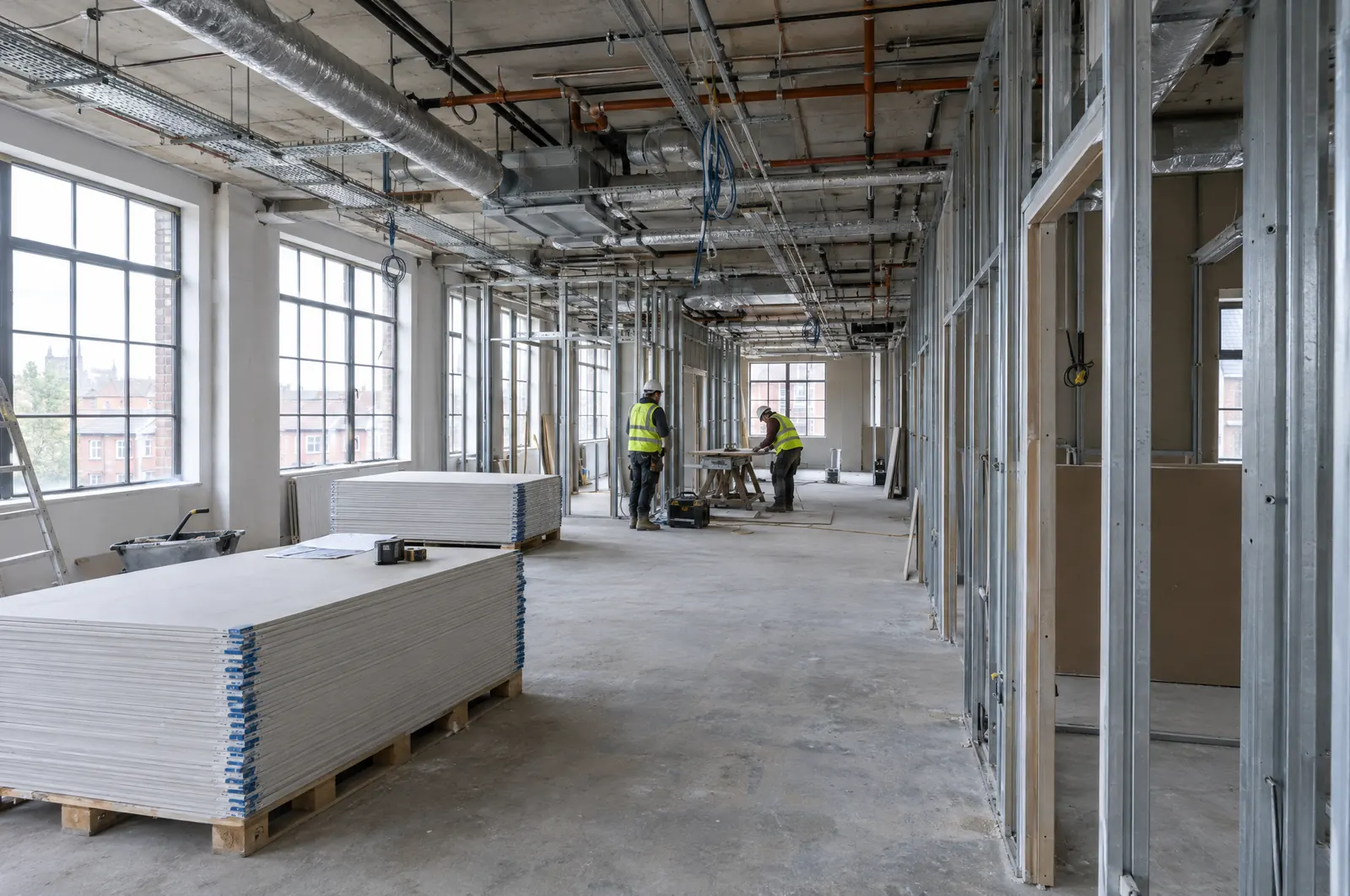
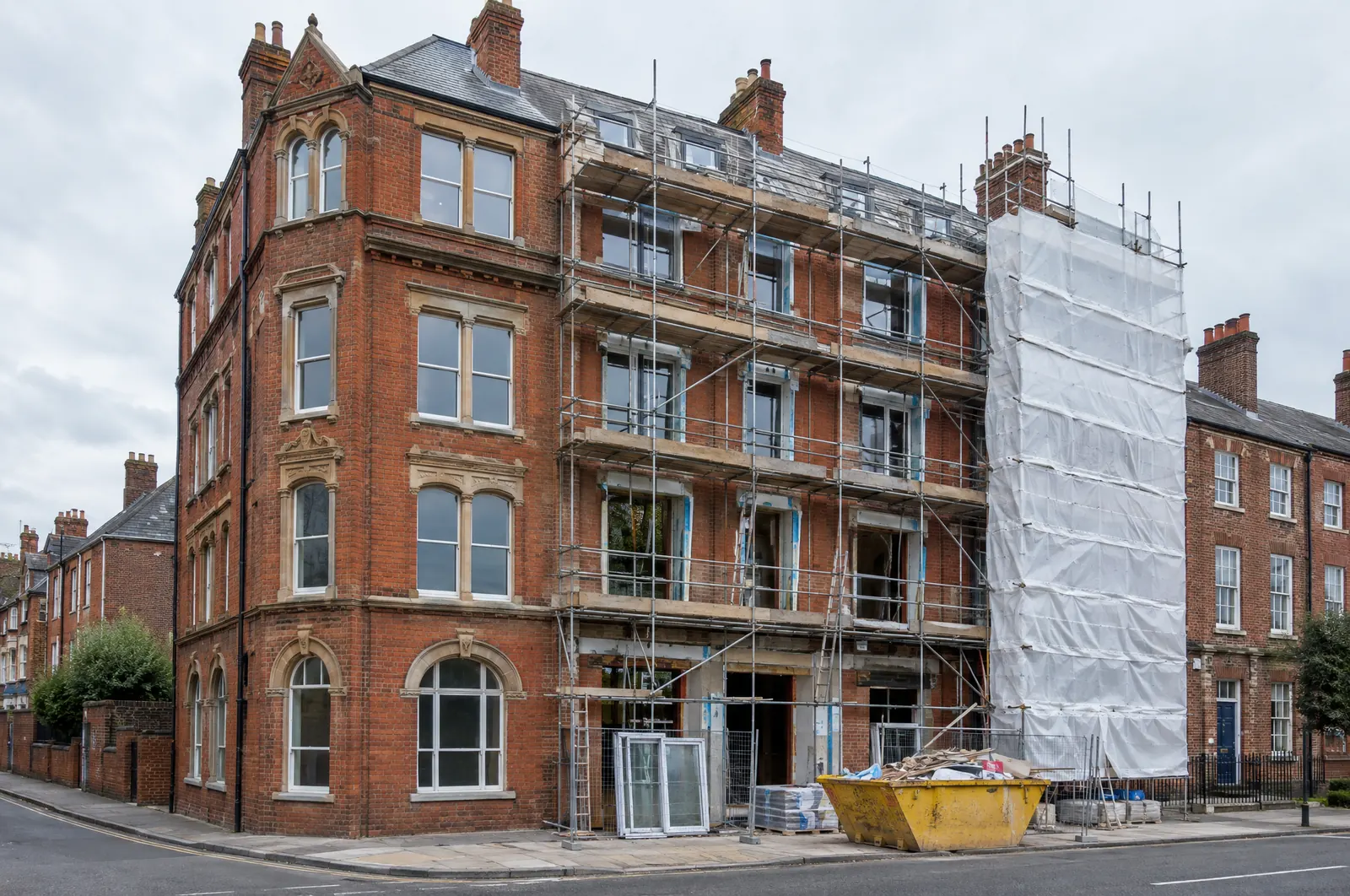
A former bank converted into eight flats
A developer receives a tender of £640,000 before VAT to convert a three-storey former bank into eight flats for sale. The tender applies 20% to every line.
| Item | Net | Rate | VAT |
|---|---|---|---|
| Strip-out, demolition and structural openings | £88,000 | 5% | £4,400 |
| Partitions, floors, ceilings and fire separation | £152,000 | 5% | £7,600 |
| Windows, doors and external envelope | £97,000 | 5% | £4,850 |
| Mechanical, electrical and plumbing installations | £139,000 | 5% | £6,950 |
| Fitted kitchens and bathrooms | £84,000 | 5% | £4,200 |
| Preliminaries and site set-up | £42,000 | 5% | £2,100 |
| Kitchen appliances | £20,000 | 20% | £4,000 |
| Carpets and underlay | £12,000 | 20% | £2,400 |
| Fitted wardrobes | £6,000 | 20% | £1,200 |
| Total | £640,000 | £37,700 |
- VAT if quoted at 20% throughout
- £128,000
- VAT rated line by line
- £37,700
- Difference
- £90,300
An example to show how the rates fall across a typical commercial conversion. It is not a figure for your project.
How we help with commercial to residential conversions
We establish whether your building and your scheme meet the tests for the reduced rate, and how the contractor's work should be invoiced. You get a clear answer on whether the conversion qualifies, with the reasoning written down for the contractor and for your accountant. Where part of the job is correctly 20%, the answer says which part.
A line-by-line analysis then gives you the rate for every part of the tender, with the reasoning for each, and a letter for the contractor. It is worth doing before the contract is signed, when the right rates can still be written into the price. There is more on our page for property developers. To start, send us your quote.
Questions
What is the VAT on converting commercial property to residential?
The contractor's rate is 5% where the work turns a non-residential building into one or more dwellings and the conditions are met. That covers labour and the building materials the contractor supplies and fits. Carpets, appliances, fitted furniture other than kitchens and professional fees are 20%.
Is an office to residential conversion zero rated?
Not the building work, unless the customer is a relevant housing association. For any other customer the contractor charges 5%. What is zero rated is the developer's first sale or long lease of the finished homes.
Can a developer recover the 5% VAT on a conversion?
A developer who sells the converted dwellings, or grants a lease of more than 21 years, makes a zero-rated first grant, and that supply is what allows recovery of the 5% charged by the contractor. Recovery is made through your own VAT return, which stays with you and your accountant. We do not file returns.
Based on the Value Added Tax Act 1994 and HMRC's published guidance. This page explains how the rules work in general. It is not advice on your project, and no rate applies until the facts have been analysed.